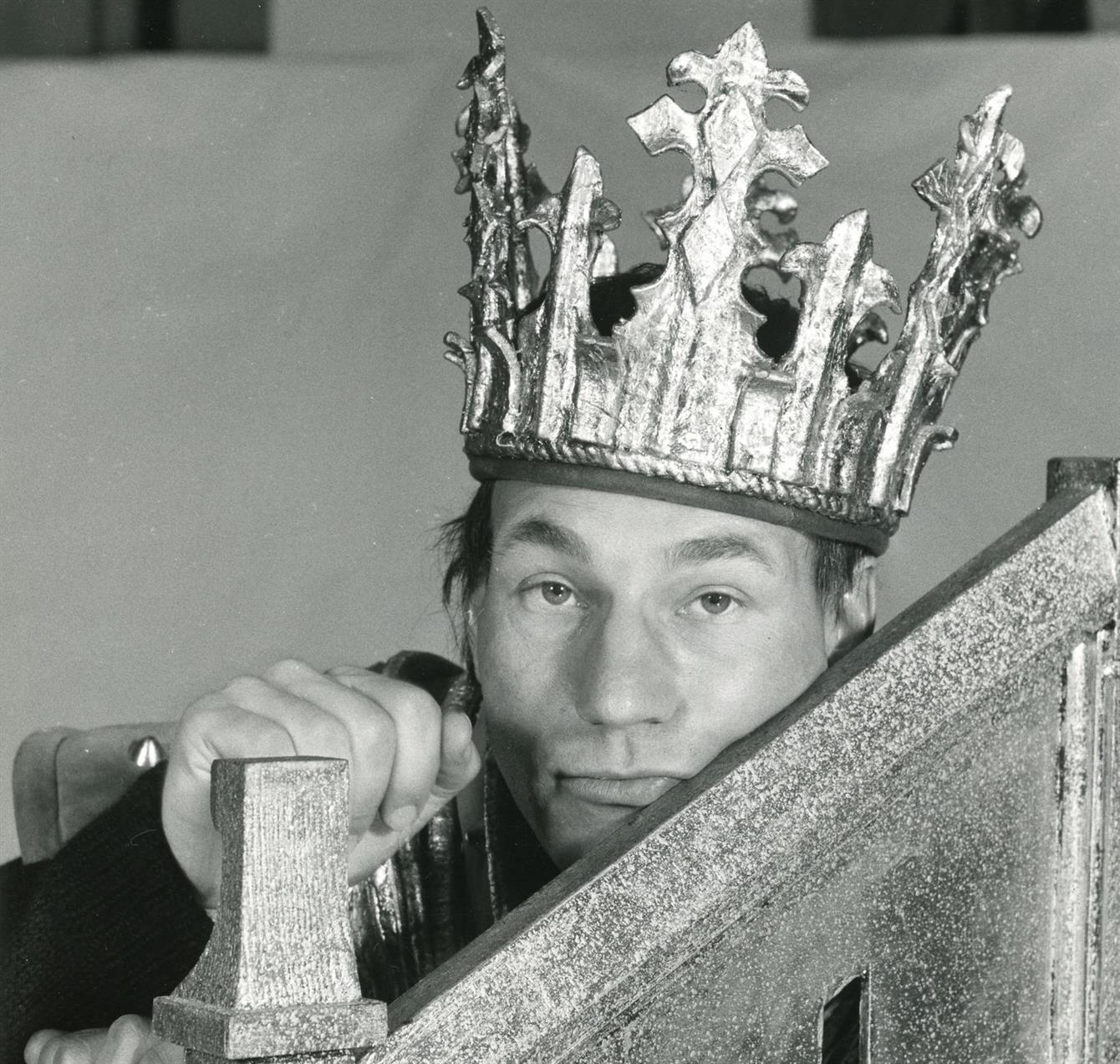
Sir Patrick Stewart (1940–2026): The Voice That Carried Shakespeare to the Stars
Sir Patrick Stewart (1940–2026), the celebrated Shakespearean actor and international screen icon, leaves an extraordinary legacy in theatre, cinema and television. The Rameshwar Prem Foundation pays tribute to an artist whose commanding presence, remarkable voice and lifelong dedication to performance inspired generations.
Before he commanded a starship, Patrick Stewart commanded the stage. Before millions recognised him as Captain Jean-Luc Picard or Professor Charles Xavier, he had already spent decades inhabiting the worlds of Shakespeare, discovering the emotional complexities of human existence through theatre. His commanding voice, extraordinary discipline and unmistakable presence eventually made him one of the most respected actors of his generation. With his passing on 28 October 2026, the world of performing arts has lost not merely an internationally celebrated performer but an artist whose life demonstrated the enduring relationship between classical theatre and contemporary cinema.
Born on 13 July 1940 in Mirfield, West Yorkshire, England, Patrick Stewart grew up in a working-class household where financial hardship and domestic difficulties shaped his early experiences. Theatre became an unexpected refuge. Encouraged by his schoolteacher, Cecil Dormand, he discovered Shakespeare at an early age and gradually developed a passion for acting. The imaginative freedom of performance offered him possibilities beyond the circumstances of his childhood. After briefly working as a journalist, he received financial support to study at the Bristol Old Vic Theatre School, where his natural abilities developed into disciplined theatrical craftsmanship. What began as an escape from an uncertain childhood eventually became a lifelong artistic commitment.
Stewart's professional journey took him through Britain's repertory theatre system before he joined the prestigious Royal Shakespeare Company in 1966. His association with the company continued for approximately sixteen years, establishing the foundations of his reputation as a remarkable classical actor. He performed numerous Shakespearean characters, including Shylock in The Merchant of Venice, King John, Leontes in The Winter's Tale, Mark Antony in Antony and Cleopatra, and Titus Andronicus. Each performance demanded a distinctive understanding of language, psychology and physical expression. Stewart possessed an unusual ability to communicate authority and vulnerability simultaneously, allowing characters of considerable power to reveal their deepest uncertainties.
His interpretation of Shylock in John Barton's 1978 production of The Merchant of Venice remains an important moment in his theatrical career. Rather than presenting the character through simplistic moral divisions, Stewart explored the contradictions of a man shaped by humiliation, anger, prejudice and a desperate determination to defend his dignity. His ability to discover emotional complexity within a familiar dramatic character demonstrated the intellectual seriousness of his approach to acting. Stewart understood that theatre was not simply the recitation of beautifully written dialogue; it was a confrontation with the contradictions of human behaviour.
Although internationally recognised for his work in cinema and television, Stewart repeatedly returned to the stage. His performances in Macbeth, Hamlet and The Tempest reaffirmed his relationship with Shakespeare. His remarkable one-man adaptation of Charles Dickens' A Christmas Carol revealed another dimension of his theatrical imagination, as he transformed himself into multiple characters through changes in voice, gesture and expression. His collaborations with his close friend Sir Ian McKellen in Samuel Beckett's Waiting for Godot and Harold Pinter's No Man's Land brought together two distinguished performers whose understanding of silence, timing and emotional restraint transformed apparently ordinary conversations into powerful theatrical experiences.
In 1987, Stewart entered an entirely different artistic universe when he accepted the role of Captain Jean-Luc Picard in Star Trek: The Next Generation. Initially unfamiliar with the cultural significance of the franchise, he approached the character with the discipline of a Shakespearean actor. His Picard was not simply a commander navigating distant galaxies; he was a thoughtful human being confronting ethical dilemmas, political conflicts and questions about civilisation itself. Stewart brought intellectual authority and moral seriousness to popular science fiction, demonstrating that television entertainment could also examine profound philosophical concerns. The series established him as an international cultural figure, and he later returned to the character in several feature films and Star Trek: Picard.
His second major cinematic identity emerged in 2000 when he portrayed Professor Charles Xavier in X-Men. Through this character, Stewart introduced an unusual sensitivity to the superhero genre. Xavier's belief in coexistence, education and the dignity of those regarded as different provided an emotional foundation for the films. His performances alongside Ian McKellen, who portrayed Magneto, created a compelling dramatic relationship between two opposing visions of society. Even within spectacular cinematic productions, Stewart's theatrical instincts remained visible in the measured delivery of dialogue, carefully controlled expressions and profound emotional restraint that characterised his work.
His filmography also included Excalibur (1981), Dune (1984), Conspiracy Theory (1997) and Logan (2017). The latter offered one of his most affecting screen performances, presenting an ageing Charles Xavier whose physical and mental vulnerability exposed the fragility behind a once-powerful figure. Stewart's ability to move between classical tragedy, science fiction, psychological drama and popular entertainment demonstrated the extraordinary adaptability of his craft. Yet regardless of the medium, he never abandoned the central principles of theatrical performance: truthfulness, concentration, disciplined imagination and respect for the written word.
Recognition followed throughout his career. He received Laurence Olivier Awards for his theatrical work, earned a Tony Award nomination for Macbeth, and was knighted by Queen Elizabeth II in 2010 for his services to drama. His artistic achievements were accompanied by a commitment to social concerns, particularly his advocacy against domestic violence. Drawing upon painful experiences from his own childhood, Stewart supported organisations working to protect vulnerable individuals and families. His 2023 memoir, Making It So, offered a deeply personal reflection on the experiences, relationships and artistic choices that shaped his remarkable journey.
What makes Patrick Stewart's artistic legacy especially significant is his refusal to treat theatre and cinema as separate worlds. For him, the actor's fundamental responsibility remained unchanged, whether performing before a few hundred spectators or appearing on screens watched by millions. He carried the discipline of classical theatre into modern popular culture, introducing generations of international audiences to the emotional possibilities of serious acting. His voice became instantly recognisable, but it was the humanity behind that voice that gave his performances their enduring power.
TRPF REMEMBERS
The Rameshwar Prem Foundation (TRPF) pays its heartfelt tribute to Sir Patrick Stewart, an extraordinary performer whose contributions to theatre, cinema and television enriched the cultural imagination of audiences across generations.
For a foundation dedicated to preserving theatrical literature, performance history and cultural memory, Stewart's artistic journey represents an important reminder that the stage remains a vital foundation of dramatic expression. His career demonstrated how the traditions of classical theatre can continue to influence new artistic forms without surrendering their emotional or intellectual depth.
The characters he portrayed will continue to speak to audiences, but perhaps his greatest contribution lies in the example he leaves for future generations of actors: an unwavering commitment to the craft, an openness to artistic exploration and a profound respect for the human experiences that theatre seeks to illuminate.
The curtain has fallen on an extraordinary life, but Patrick Stewart's performances remain part of the living memory of world theatre.
The Rameshwar Prem Foundation salutes an artist whose voice reached the stars, but whose heart always belonged to the stage.